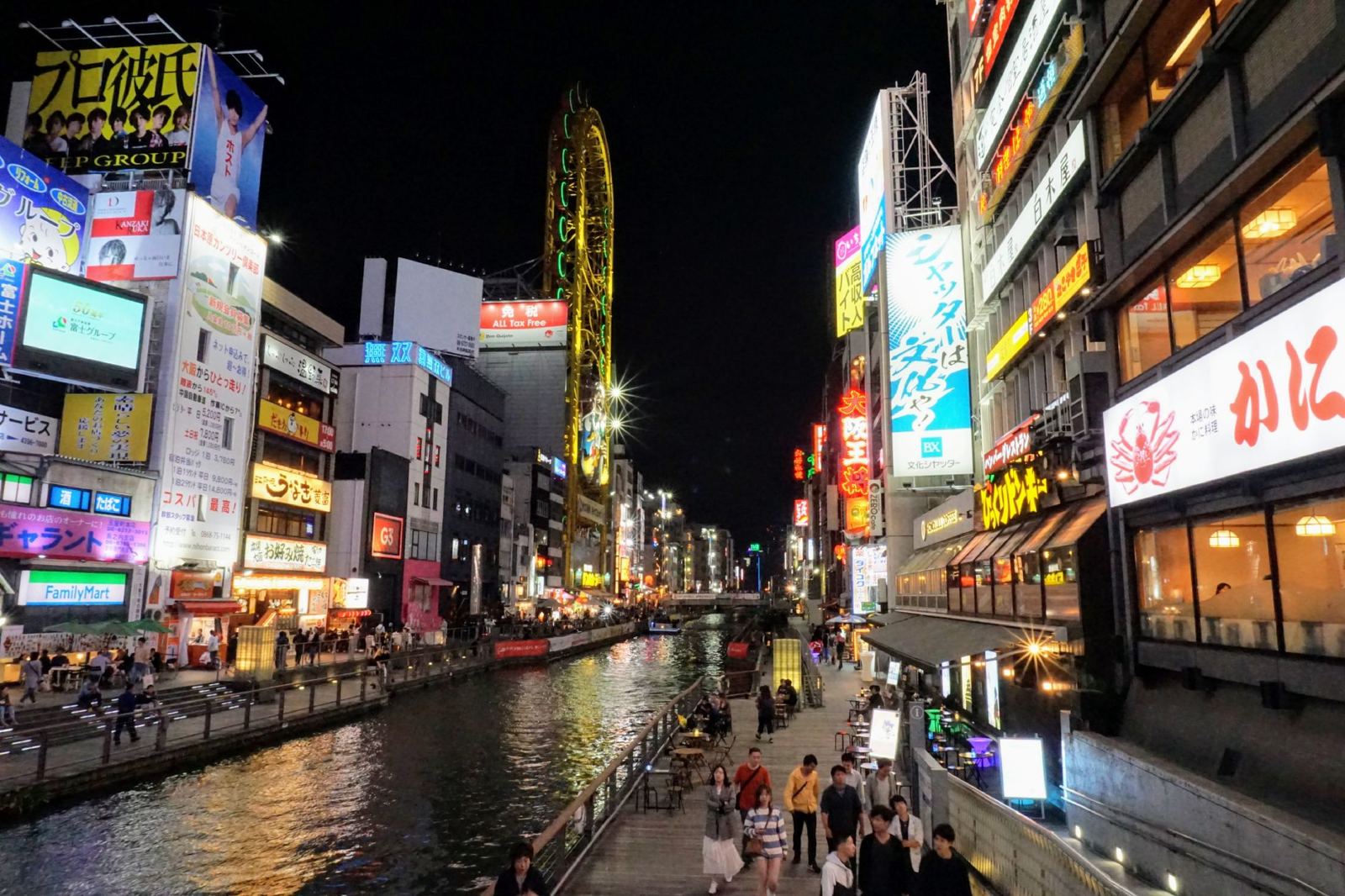
Osaka answers Tokyo's seriousness with a laugh: this is the Japan that raises comedians, strikes up conversation with strangers and cares more about the table than the queue. 'Kuidaore' — eating until you drop — is the city's unofficial constitution, re-enacted nightly under the neon of the Dotonbori canal.
Historically a merchant city rather than a samurai one, that legacy shows in today's direct, bargaining, warm character. Kyoto's elegance and Nara's deer are half an hour away — Osaka is the Kansai region's best base and, on its own, its most entertaining stop.
When to Go
Late March–early April for sakura (the castle park turns into a pink sea) and October–November for autumn clarity are the two best windows. Summer is humid and hot, but the Tenjin Matsuri in July — river processions and fireworks, among Japan's biggest festivals — makes it worthwhile. Winter is mild; a food city knows no off-season.
What to See & Do
See Dotonbori twice: a calm canalside walk by day, a neon carnival under the Glico runner sign by night. One street over, the stone lane of Hozenji Yokocho and its moss-covered Buddha deliver the city's two faces in a single frame — quiet just a block from the roar.
Osaka Castle with its park takes half a day; the museum inside the keep is modern, and the real pleasure lies in the walls and moats. The open rooftop ring of the Umeda Sky Building is Kansai's best sunset platform. The Shinsekai district, with its retro Tsutenkaku tower and kushikatsu joints, is old-Osaka nostalgia.
Kuromon market earns its 'Osaka's kitchen' title with its morning stalls. Amerikamura covers youth fashion, Den Den Town the electronics-anime chapter. With kids or a theme-park appetite, Universal Studios Japan (Nintendo World included) takes a full day. Day trips are generous: Nara's free-roaming deer and Great Buddha are 45 minutes away, Kyoto 15 minutes by shinkansen, and Kobe and Himeji Castle (Japan's most beautiful original castle) each about an hour.
Food & Drink
Osaka's holy trinity is settled: takoyaki (octopus balls — from a street griddle, still steaming), okonomiyaki (the cabbage pancake-omelette hybrid, cooked on the teppan) and kushikatsu (breaded skewers — the 'no double-dipping in the sauce' rule is serious). All cheap, filling and eaten at the counter.
At Kuromon market, scallops, prawns and wagyu skewers are tasted stall to stall. Kansai-style udon (soft, with a sweetish broth) and kitsune udon were invented here. For the evening, the izakaya alleys of Ura-Namba are where the local crowd goes. For dessert, the freshly baked jiggly soufflé cheesecake has become synonymous with the city. Note: food queues in Osaka move faster than Tokyo's — counter culture here prefers eat-and-walk to sit-and-linger.
Practical Tips
The ICOCA card (Suica's Kansai sibling) works on all trains, metro and convenience stores; a Suica from Tokyo works identically. From Kansai Airport, the Nankai express or JR Haruka train is the practical route.
For day-trip-heavy plans, price the Kansai Thru Pass or JR regional passes — they pay off on the Nara+Kyoto+Kobe combination. On escalators, stand on the right — the opposite of Tokyo (a Kansai custom). Evening crowds around Dotonbori are dense but never unsafe. The plastic food models (sampuru) in restaurant windows solve menu reading — trust the display where you can't read the menu. Buy Universal Studios express passes in advance and go on a weekday. Cash remains the language of the small stalls.